Overview
Arduino Course in Pakistan Learn Arduino Programming
Technology is no longer limited to software alone. Today’s innovations are powered by intelligent devices that can sense, process information, make decisions, and interact with the physical world. From smart home systems and automated machines to robotics and Internet of Things (IoT) applications, embedded technologies are transforming how we live and work.
At the center of many of these innovations is Arduino, one of the world’s most popular open-source development platforms. Known for its simplicity, flexibility, and powerful capabilities, Arduino has become the preferred learning platform for students, engineers, educators, makers, and technology enthusiasts who want to explore programming, electronics, automation, and robotics.
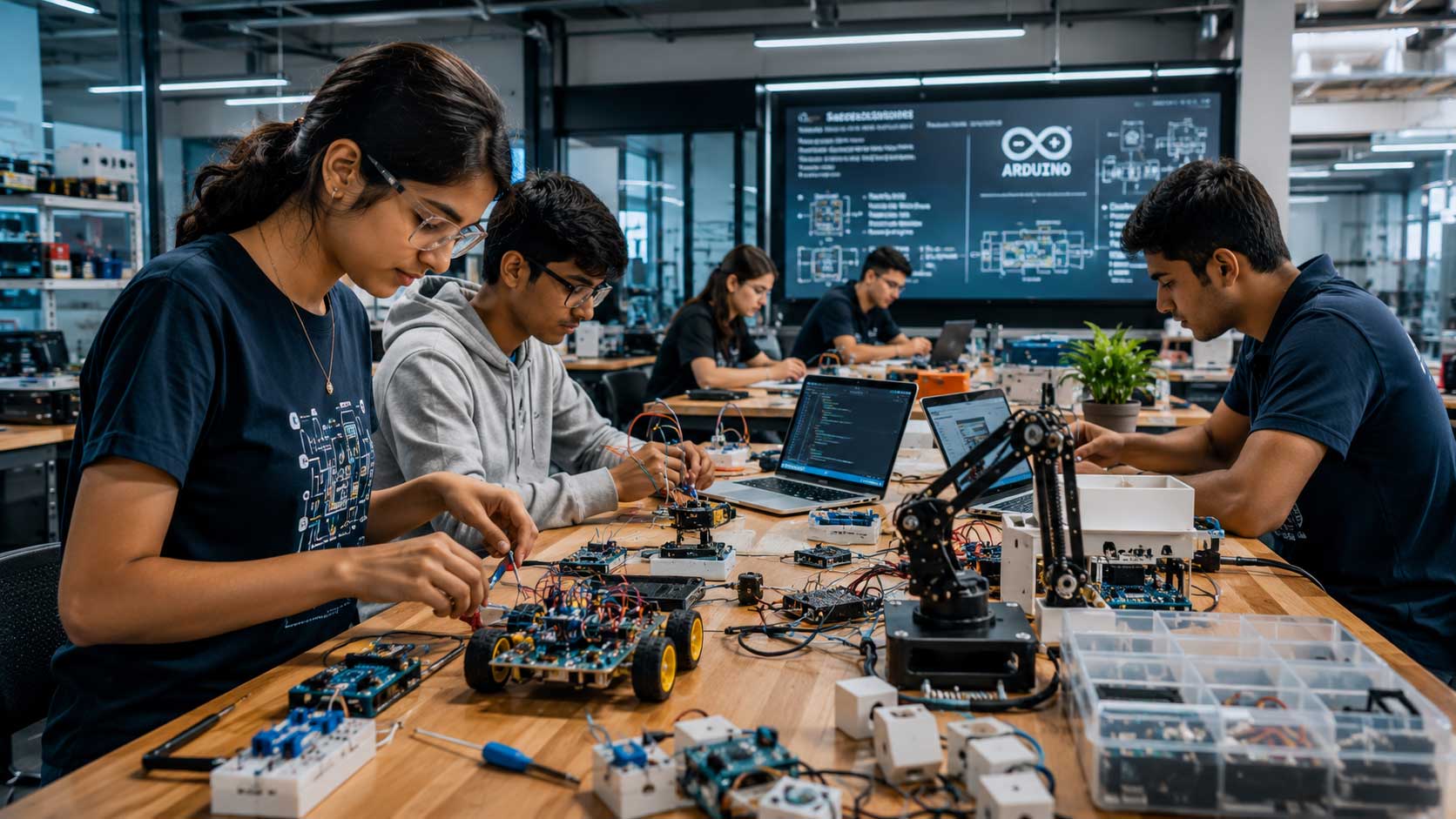
The Arduino Course in Pakistan offered by DiySpace Robotics is designed to help learners build practical skills in Arduino programming, embedded systems, sensor integration, and hardware development through project-based learning. Instead of simply learning theory, participants work directly with Arduino boards, sensors, actuators, displays, and automation systems to create functional technology projects.
Whether your goal is to build robots, develop IoT applications, automate everyday tasks, or strengthen your engineering knowledge, this course provides a structured pathway from beginner-level concepts to real-world implementation.

Understanding the Power of Arduino
Arduino is a microcontroller-based development platform that enables users to create interactive electronic systems by combining hardware and software. An Arduino board can receive information from sensors, process that information through programmed instructions, and control outputs such as LEDs, motors, displays, relays, and communication devices.
One of the reasons Arduino has become so widely adopted worldwide is its accessibility. Beginners can quickly start building projects without requiring extensive prior experience in programming or electronics. At the same time, professionals and engineers use Arduino for rapid prototyping, product development, automation testing, and embedded systems research.
For students entering STEM fields, Arduino serves as an ideal bridge between theoretical learning and practical engineering. It introduces core concepts of microcontrollers, embedded programming, electronics, and system design in a way that is both engaging and hands-on.
Today, Arduino is used extensively in educational institutions, research laboratories, robotics competitions, innovation centers, and industrial prototyping environments around the world. Learning Arduino not only develops technical knowledge but also strengthens creativity, logical thinking, and problem-solving skills.
A Learning Experience Built Around Real Projects
At DiySpace Robotics, learning happens through exploration, experimentation, and project development.
Rather than memorizing programming syntax or circuit diagrams, students actively build systems, write code, connect hardware, test functionality, and solve practical challenges. This project-based approach helps learners understand how individual concepts work together to create complete technology solutions.
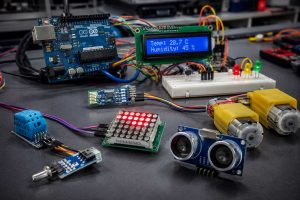
Every module combines programming exercises with hardware interaction. Students learn how software instructions can control physical devices, collect sensor data, automate actions, and respond intelligently to changing conditions.
As learners progress, they move from simple Arduino programs to increasingly sophisticated systems that integrate multiple sensors, communication modules, displays, and automation features.
This practical methodology ensures that knowledge gained during training remains meaningful, applicable, and transferable to real engineering projects.
From Coding to Hardware Integration
Learning Arduino involves much more than writing code.
The journey begins with understanding the Arduino development environment, programming fundamentals, and basic electronic circuits. Students learn how microcontrollers process information and how software instructions influence hardware behavior.
Once the fundamentals are established, learners begin working with sensors, buttons, LEDs, buzzers, displays, and motors. They discover how input devices gather information from the environment and how output devices respond to programmed commands.
As confidence grows, students learn how to integrate multiple components into complete systems. These projects demonstrate how modern technologies such as automation systems, smart devices, robotics platforms, and IoT applications are built.
The result is a learning experience that develops both programming skills and engineering understanding simultaneously.
Technologies Explored During the Course
Arduino Programming Fundamentals
Learn variables, conditions, loops, functions, and structured programming techniques using the Arduino IDE.
Digital and Analog Inputs
Understand how microcontrollers process different types of signals and interact with electronic components.
Sensor Interfacing
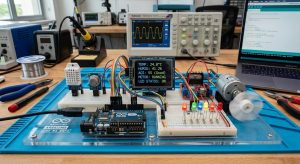
Work with sensors that detect temperature, distance, motion, light, humidity, and environmental conditions.
Motor Control Systems
Learn how to control DC motors, servo motors, and automation mechanisms using Arduino.
LCD and Display Integration
Develop user-friendly interfaces that display information and system status.
Communication Protocols
Explore serial communication, I2C, and SPI technologies used in modern embedded systems.
Embedded Systems Concepts
Understand how hardware and software interact to create intelligent electronic products.
IoT Applications
Discover how Arduino devices communicate with networks, cloud platforms, and smart systems.
Automation Projects
Build practical solutions that automate tasks and respond to environmental conditions.
Building Solutions That Solve Real Problems
The true value of Arduino lies in its ability to transform ideas into functional systems.
Throughout the course, students work on projects that simulate real-world technology challenges and engineering applications.
Projects may include Smart Home Automation Systems that control lighting and appliances, Obstacle Detection Systems used in robotics, and Weather Monitoring Projects that collect and display environmental data.
Learners also explore Motion Sensor Applications, Automatic Lighting Systems, Environmental Monitoring Solutions, and IoT-Based Smart Devices capable of collecting and transmitting information.
These projects help students understand how engineering principles are applied to solve practical problems while developing confidence in designing and building technology systems independently.
Who Can Join This Course?
This course is designed for anyone interested in learning modern technology through practical experience.
- School Students
- College & University Students
- Engineering Learners
- Robotics Enthusiasts
- Teachers & STEM Educators
- Makers & Hobbyists
- Electronics Beginners
- Professionals Exploring Embedded Systems
No prior Arduino or programming experience is required.
Certification & Portfolio Development
Upon successful completion, participants receive a Course Completion Certificate from DiySpace Robotics.
More importantly, learners graduate with practical project experience and a portfolio demonstrating their ability to program microcontrollers, integrate sensors, develop automation systems, and create functional embedded applications.
This combination of certification and project work provides valuable evidence of technical capability for future academic, professional, and innovation opportunities.
Why Arduino Remains a Future-Proof Technology Skill
As Industry 4.0, automation, robotics, artificial intelligence, and connected devices continue to reshape industries, the demand for individuals who understand embedded technologies continues to grow.
Arduino provides an accessible entry point into these rapidly expanding fields. The skills developed through Arduino programming support further learning in Embedded Systems, Robotics Engineering, IoT Development, Automation Technologies, Product Development, and Technology Entrepreneurship.
For students and professionals preparing for future technology careers, Arduino remains one of the most practical and valuable platforms for building real-world engineering skills.
Curriculum
Instructor

Course Features
- Lecture 0
- Quiz 0
- Duration 10 weeks
- Skill level All levels
- Language English
- Students 2
- Assessments Yes